
Sort It Out
Sort It Out (SIO) is the second and latest iteration of Zero Waste SG's Let's Recycle Together campaign. The rebrand reflects a sharpened focus on waste segregation at source as a foundational step towards effective recycling.
Launched in June 2024, SIO advocates for separating recyclables such as plastics, paper, metals, and glass at the point of waste generation. Proper segregation reduces contamination, improves recycling quality, and ensures that more materials can be reprocessed into new products instead of ending up in landfills or incineration plants.
Why Source Segregation?

A Glimpse into Singapore's Recycling System
Singapore's household recycling system has relied on co-mingled single-stream collection, where mixed recyclables are collected together and sorted later at the Material Recovery Facility (MRF), since the launch of the National Recycling Programme (NRP) in 2001. While convenient, this system often results in recyclables being mixed with non-recyclable or soiled waste, causing contamination. Contaminated recyclables are difficult to process and frequently end up being diverted to general waste, reducing recycling effectiveness and remain as a major barrier to efficient recycling.
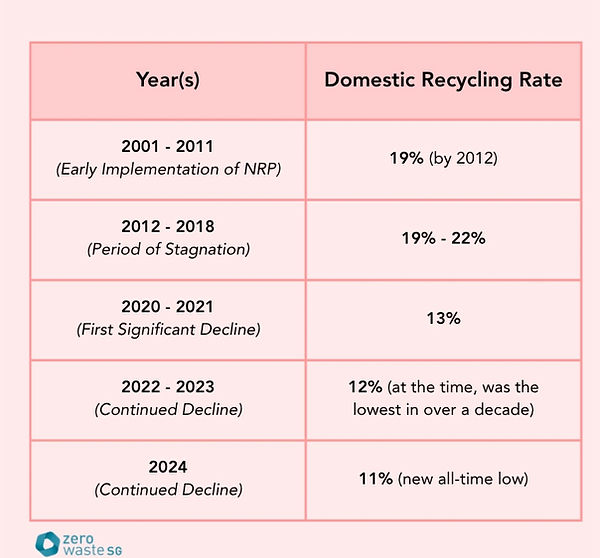
Singapore's Domestic Recycling Rate Trends (2001 - 2024):
Currently, Singapore’s domestic recycling rate is hovering near record lows, far below the national target of 30% by 2030 set under the Singapore Green Plan 2030. Of the recyclables collected, only about 60% are actually recycled. The remaining 40% are contaminated, incinerated, and sent to our rapidly filling Semakau landfill, which is projected to reach capacity by 2035.
These trends underscore the urgent need to improve recycling practices and reduce waste.
_edited.jpg)
Multi-Stream Recycling for Better Outcomes
To address this challenge, we turn to segregation at source as a key solution to preserving material quality and improving recycling outcomes.
By segregating recyclables such as paper, plastic, metal, and glass at the point of disposal, contamination can be significantly reduced, improving recycling quality and efficiency.

Let's look at the benefits of multi-stream recycling
Segregating waste at the source delivers clear benefits, including:
-
Reducing contamination by keeping clean recyclable streams separate.
-
Smaller carbon and energy footprint by eliminating extensive backend sorting and cleaning.
-
Producing higher quality recyclables that are easier to reprocess and integrate into a circular supply chain.
-
Promoting a cleaner environment, cultivating waste awareness, and encouraging responsible, mindful management of the waste we generate.
-
Building waste consciousness by prompting individuals to pause and think before disposal, as segregated bins require active sorting rather than passive throw-and-go behaviour.
What Is the Optimal System: Multi-Stream Recycling in a Closed-Loop System
Closed-loop recycling is a sustainable system where used products are collected, recycled, and remade into the same product or high-quality material, creating a continuous cycle that minimizes waste and reliance on virgin resources.


Closed-Loop Partners Network launched in 2024 - a first-of-its-kind platform in Singapore aimed at fostering industry partnerships to advance a circular economy. This aligns with Singapore's vision towards a Zero Waste Nation. The network aims to bridge the supply and demand gap for recycled feedstock by fostering collaboration among recycling service providers and enabling recycling through innovative waste management solutions and waste tracking, which is essential in rebuilding confidence in recycling via this new multi-stream recycling infrastructure.
SIO Pilot Recycling Hubs
As part of SIO, in 2025 Zero Waste SG launched two pilot Recycling Hubs concurrently in Queenstown and Pioneer to introduce smart segregated recycling bins and promote improved recycling habits. On top of setting up the infrastructure to make source segregation accessible and practical for residents, the campaign also runs educational and engagement outreach events to ensure that residents of each neighbourhood are equipped with knowledge on how to recycle and how to use the recycling bins correctly. Door to door surveys are conducted as part of the educational and engagement outreach, as well as gather essential ground data from the residents.
SIO also raises awareness amongst households, reinforcing responsible consumption and disposal habits to reduce waste, promoting waste mindfulness and consciousness.

SIO Recycling Hub @ Frontier CC (Pioneer)

SIO Recycling Hub @ Blk 181 Stirling Rd (Queenstown)
Implementing and promoting Sorting at Source not only enhances recycling rates but also supports Singapore’s broader circular economy goals, ensuring that resources are reused and recycled rather than wasted. Through education, community engagement, and practical initiatives, Singapore can transition from convenience-driven recycling to a more sustainable, effective, and circular approach.
Evidence and Real-World Impact
Our two SIO Recycling Hubs in Queenstown and Pioneer have shown promising early signs of impact.
In 10 months, over 8,100kgs of clean-stream recyclables have been collected, with a contamination rate of less than 5% at both locations.
Segregation at source is not just a technical improvement; it’s a behavioural catalyst that empowers individuals and communities to participate fully in a circular economy. Through SIO, Zero Waste SG is turning everyday recycling choices into lasting environmental outcomes for Singapore.
Where To Find a Recycling Bin Near You
https://www.recycle.gov.sg/ check this link for a map of recycling bins, including BCRS RVM return points, textile bins, and e-waste bins!