Visit Greenstore Today!

Zero Waste


Zero Waste is a concept that challenges the old way of thinking about waste as something that has no value and to be thrown away. According to the Zero Waste Alliance:

Zero waste suggests that the entire concept of waste should be eliminated. Instead, waste should be thought of as a “residual product” or simply a “potential resource” to counter our basic acceptance of waste as a normal course of events. Opportunities such as reduced costs, increased profits, and reduced environmental impacts are found when returning these “residual products” or “resources” as food to either natural and industrial systems.

Zero Waste is a whole system approach that changes the way materials flow through society and ultimately results in no waste. It involves reducing consumption, minimising wastage, maximising recycling and composting, and ensuring that products and materials are designed to use less resources and made to be reused, recycled or biodegradable.

Nature is the best Zero Waste model. There is no waste in nature and by-products produced become resources for others or are assimilated harmlessly back to the surroundings.

The Zero Waste Hierarchy

The Zero Waste hierarchy refers to the following options for managing waste (in order of priority):

  1. Right in the beginning, waste should be prevented or reduced through redesign, reduced packaging and material use, and less consumption.
  2. Waste should be reused, repaired or refurbished for their original use or for another purpose.
  3. Waste should be recycled, reprocessed or composted into raw materials and useful resources.
  4. Waste should be recovered for their energy content through waste-to-energy or incineration facilities.
  5. After all of the above have been done, waste should be landfilled in a safe and sustainable manner.

Benefits of Zero Waste

The benefits of Zero Waste is that it helps to conserve our resources, reduce pollution, create jobs in waste management, reduce waste costs, increase the lifespan of our Semakau Landfill and incineration plants, and mitigate climate change.

Zero Waste is an extraordinary concept that can lead society, business, and cities to innovative breakthroughs that can save the environment, lives, and money. Through the lens of Zero Waste, an entirely new relationship between humans and systems is envisaged, the only one that can create more security and well being for people while reducing dramatically our impact upon planet earth. The excitement is on two levels: it provides a broad and far-reaching vision, and yet it is practical and applicable today. – Paul Hawken, environmentalist and author (from the publication, The End of Waste, by the Zero Waste New Zealand Trust)

Can We Achieve Zero Waste?

Zero is the goal but it is important not to be over-focused on the word ‘zero’. What matters is the concept behind Zero Waste. The road to Zero Waste is a long journey and it requires the efforts of individuals, communities, organisations, businesses and the government, working closely together towards Zero Waste. We invite all Singaporeans to support the vision of a Zero Waste Singapore.

Yes We Can.

The 3Rs

You can take action by practising the 3 Rs in your daily lives – Reduce, Reuse and Recycle (in order of sequence). The sequence is important, as source reduction is usually the best way to minimise waste while recycling still has some impact on the environment and should be done last.

1. Reduce by eliminating or minimising the waste in the beginning.

2. Reuse by using the waste several times in its original form or for another purpose.

3. Recycle by sending the waste to be processed as a resource for new products.

For example, let’s take a look at a plastic bottle of mineral water. Reduce by not buying the plastic bottle and drink from the tap or use your own reusable bottle instead.

But if you really have to buy the bottle of water, then reuse it after drinking the water. Reuse the plastic bottle as your water bottle for refilling, use it as a flower vase, use it for storing other liquids, or use it to make art decorative items.

After reusing the plastic bottle for some time and when it becomes dirty or damaged, don’t throw it away in the rubbish bin. Recycle the plastic bottle by depositing it into the recycling bag or bin under the recycling programme. The bottle will be collected and processed into plastic pellets that are used as feedstock for making new plastic bottles and products.

You can take action now towards Zero Waste by Reduce, Reuse and Recycle. Just follow our tips and resources found in the Reduce, Reuse and Recycle categories.

Our Waste Challenge

In Singapore, the amount of waste disposed has increased about five-fold over the past 38 years, from 0.5 million tonnes in 1970 to 2.6 million tonnes in 2008. Each person generated about 0.84 kg of domestic waste per day in 2008.

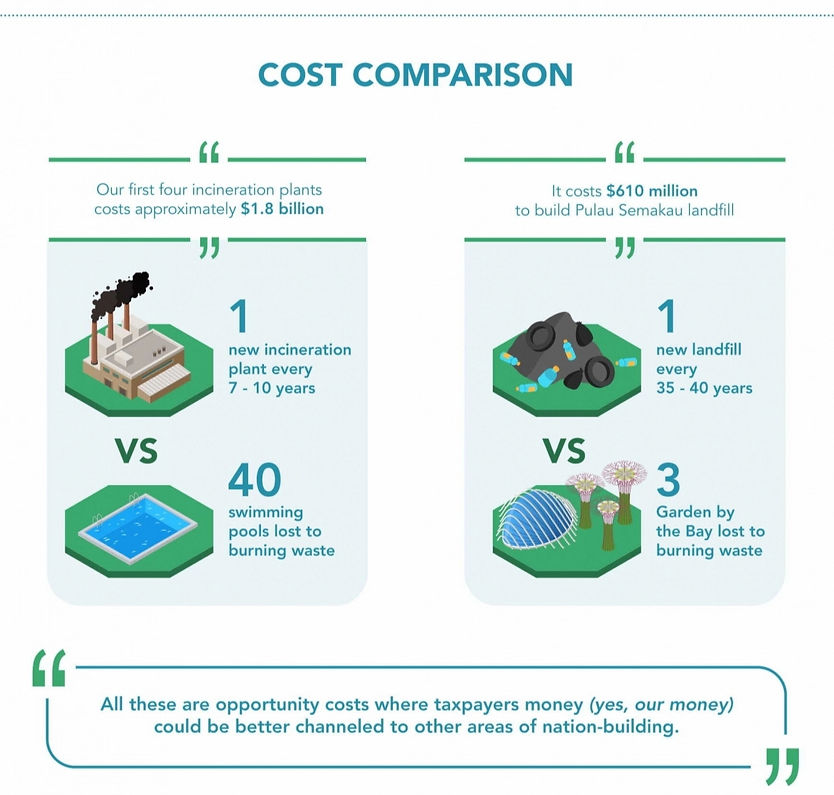
If this continues, the projected lifespan of our Semakau Landfill would be about 35 to 40 years, and additional incineration plants would have to be built every 7 to 10 years.

This poses a challenge as it is difficult to find land for the construction of new incineration plants and landfills in land-scarce Singapore.

In addition, high cost is involved in the construction of new waste disposal facilities. The construction cost is about $1.8 billion for our four existing incineration plants and $610 million for Semakau Landfill.

More importantly, the real challenge is whether we can change our current unsustainable materials economy and resource use, which follows a extract-produce-distribute-consume-dispose linear model.

This unsustainable model uses natural and energy resources to produce goods and stuff, which are consumed and disposed of as waste, resulting in economic losses and environmental degradation.

According to the Living Planet Report 2008:

Humanity’s demand on the planet’s living resources, its Ecological Footprint, now exceeds the planet’s regenerative capacity by about 30 per cent. This global overshoot is growing and, as a consequence, ecosystems are being run down and waste is accumulating in the air, land and water. The resulting deforestation, water shortages, declining biodiversity and climate change are putting the well-being and development of all nations at increasing risk.

If we continue with business as usual, by the early 2030s we will need two planets to keep up with humanity’s demand for goods and services. But there are many effective ways to change course.

If humanity has the will, it has the way to live within the means of the planet, while securing human well-being and the ecosystems on which this depends.

For a better understanding of the materials economy and our waste challenge, watch The Story of Stuff below. The Story of Stuff is a 20-minute film by Annie Leonard, which takes an interesting look at our production and consumption patterns, and the connections between environmental and social issues.

YouTube Preview Image

Waste Management in Singapore

Waste Collection

The public waste collection in Singapore is divided into nine sectors managed by four licensed Public Waste Collectors (PWCs) as shown below.

The PWCs are responsible for the collection of waste from residential and trade premises in Singapore. They are also required to provide recycling services under the National Recycling Programme (NRP). For commercial and industrial premises, the waste are collected separately by licensed general waste collectors.

Waste Disposal

The waste collected by the PWCs and general waste collectors are disposed of at the four incineration plants (Tuas, Tuas South, Senoko and Ulu Pandan) and the offshore Semakau Landfill. Waste that are incinerable are sent to the incineration plants while non-incinerable waste and incineration ashes are sent to the landfill. About 90% of waste are incinerated and 10% are landfilled.

In 2008, about 2.63 million tonnes of waste was disposed – 57% was generated from residential premises, food centres and markets; and 43% was generated from commercial and industrial premises. Each person generated about 0.84 kg of domestic waste per day.

Waste Recycling

Waste that are not disposed of are sent for recycling. In 2008, about 3.3 million tonnes of waste was recycled and an overall recycling rate of 56% was achieved. The quantity and recycling rate for each type of waste are shown in the table below:

2008-waste-statistics

Image source: NEA.

Environmental Consultancy for SMEs by Green Future Solutions

Comments

5 Comments on "Zero Waste"

  1. Sharifah on Mon, 10th Oct 2011 9:45 am 

    Hi there!

    My office use lots of paper.. and we try to recycle but ther is no recycle bin nearby. So, we are looking for recycling co. who wants this papers to recycle. If you guys do that please do email me at sharifahnurain@rocketmail.com

    Cheers!

  2. Frankie Sim on Thu, 20th Oct 2011 9:33 pm 

    Hi

    I’m a Contractor.In year 2010,There would still be people requesting us for PVC pipes,Casing and plastic. From there I would still be able to recoup part of my income. But starting of this year, Everywhere went silience, even I wanted to give it out, but no one willing to accept it and i have to throw it away, Which i find it a waste. I wanted to recycle all these PVC as to save the earth. Out there is there anyone who can help me recycle all these,I need not sell it, I can give it out to recycle for free.

    My Store is at around woodlands industrial. So Whoever can help,Please get back to me by the above mention e-mail address.

    Thanks. Await for your sincere reply.

    Best Regards
    Frankie Sim

  3. Eugene Tay on Mon, 24th Oct 2011 11:44 am 

    @Frankie, you may wish to check with the plastic collectors at http://app2.nea.gov.sg/topics_collectrade.aspx.

  4. Kimming on Sat, 24th Dec 2011 10:27 pm 

    Hi Frankie,

    I am looking for discarded PVC pipes for a project, do you still have them around? How can I reach you?

    My contact is kimmingyap@gmail.com

    Thank you.

    Regards
    Kimming

  5. DEEPAK SHARMA on Sun, 29th Jan 2012 3:42 pm 

    I need some literaure/ictures how to handle/ checklist of wet & dry garbage in hotel industry. Kindly help

Tell us what you're thinking.